Hero DMC Heart Institute · Ludhiana · CVTS
A cardiac surgery registry, built inside the unit that uses it
Every stage of a case in one record — pre-operative assessment through angiogram, theatre, perfusion, recovery and follow-up — with the scores worked out where the numbers already are, and the unit's own reports printed from it.
- Built by
- Dr Sarju Ralhan · MS, MCh (CTVS)
- Status
- In daily clinical use
- Stages recorded
- 15 linked forms
- Runs on
- One server · any browser
The problem it was built for
A unit's data is usually in three places at once: a spreadsheet somebody maintains, a stack of printed notes, and the memory of whoever was scrubbed that day.
None of those three answer a question like how many off-pump cases in the last two years, and what happened to them — and none of them stop a prescription going out with a drug missing from it. This was built to be one record, filled at the point the information exists, by the person who has it.
- Pre-operative assessmentEcho in full, renal function, EuroSCORE II worked out from the boxes as they are filled
- Angiogram & lesionsTap the vessel on a 25-segment coronary map; SYNTAX scored per segment as you go
- TheatreThe day's list across four theatres, status advancing on a tap; conduits and targets per graft
- Perfusion & anaesthesiaTimes, fluid balance, inotropes at real dilutions rather than remembered ones
- Recovery & dischargeTreatment chart, discharge summary and prescription printed on the unit's letterhead
- Follow-upThe review date becomes an appointment, and the next clinic's prescription starts from the last one
The coronary map
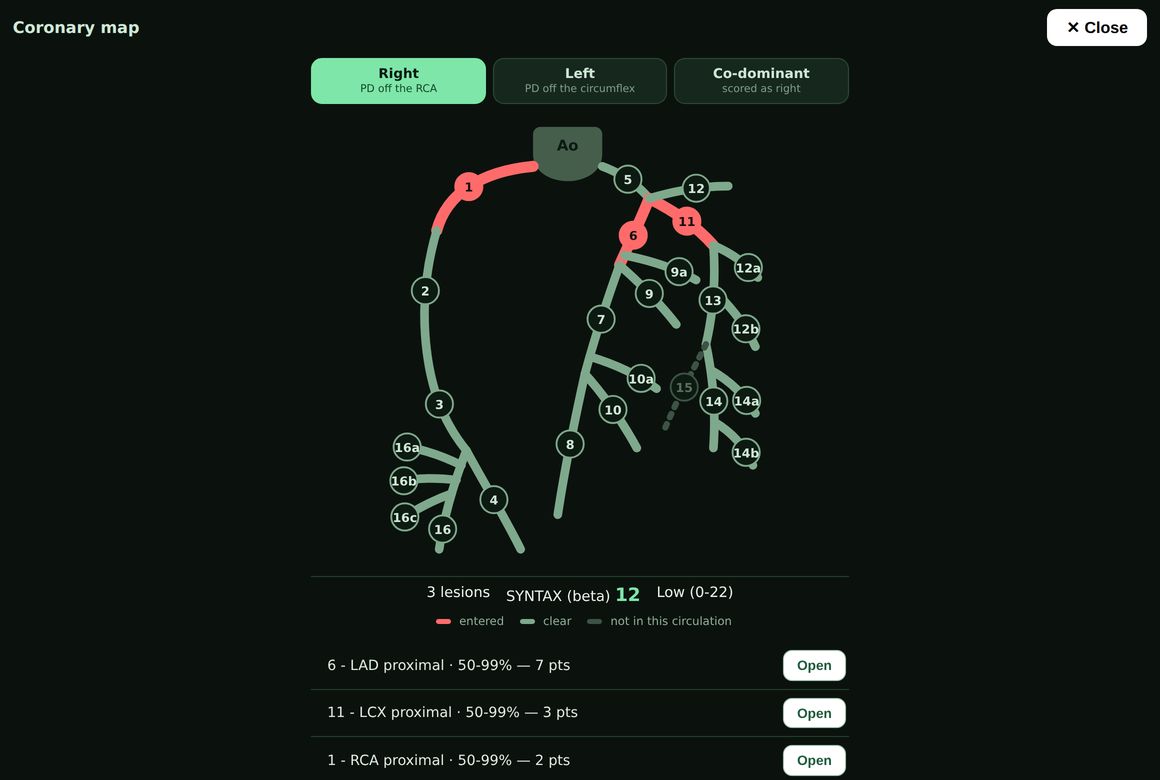
Dominance is asked first, because it decides which segments exist and what each is worth. Then you tap the vessel rather than finding it in a list.
The scores, and how far they can be trusted
A score a treatment decision leans on is worth nothing unless you can check it. So the anatomical SYNTAX weights were matched segment for segment against syntaxscore.org, on a real case.
| Segment | Stenosis | This registry | syntaxscore.org | |
|---|---|---|---|---|
| 1 — RCA proximal | 50–99% | 2 | 2 | match |
| 4 — RCA posterior descending | 50–99% | 2 | 2 | match |
| 6 — LAD proximal | 50–99% | 7 | 7 | match |
| 9a — First diagonal | 50–99% | 2 | 2 | match |
| 14 — LCX posterolateral | Total occlusion | 2.5 | 2.5 | match |
| 12a — Obtuse marginal 1 | 50–99% | 2 | 2 | match |
EuroSCORE II is computed from the pre-operative sheet. SYNTAX II four-year mortality is reconstructed from the published model (Farooq et al., Lancet 2013) — and the screen says so, every time, rather than presenting it as the vendor calculator's own figure.
- 15linked forms per case
- 25coronary segments, weighted by dominance
- 95automated test suites
- ~2,200checks run before anything ships
Two things that save the most time
Dictate the echo. Press the microphone on your own phone keyboard and say the study the way you would dictate it to a technician. Forty-eight boxes fill in. It only fills — nothing saves until you press Save, a box you have already filled is never touched, and anything it could not place is shown in the words you said rather than dropped. Dictation runs on the phone; the page never handles audio.
Or photograph the report. An angiogram or echo done outside arrives as somebody else's printed page. Photograph it and the same boxes fill, with the same rules. Where a digit is genuinely unreadable it is left empty and said so, rather than guessed at.
Nothing goes out unchecked
The prescription is written from a formulary of 1,020 brands in 102 generics, and every line is checked against every other line as it is typed — drug against drug, drug against what the patient is recorded as reacting to, and the same class written twice under two brand names.
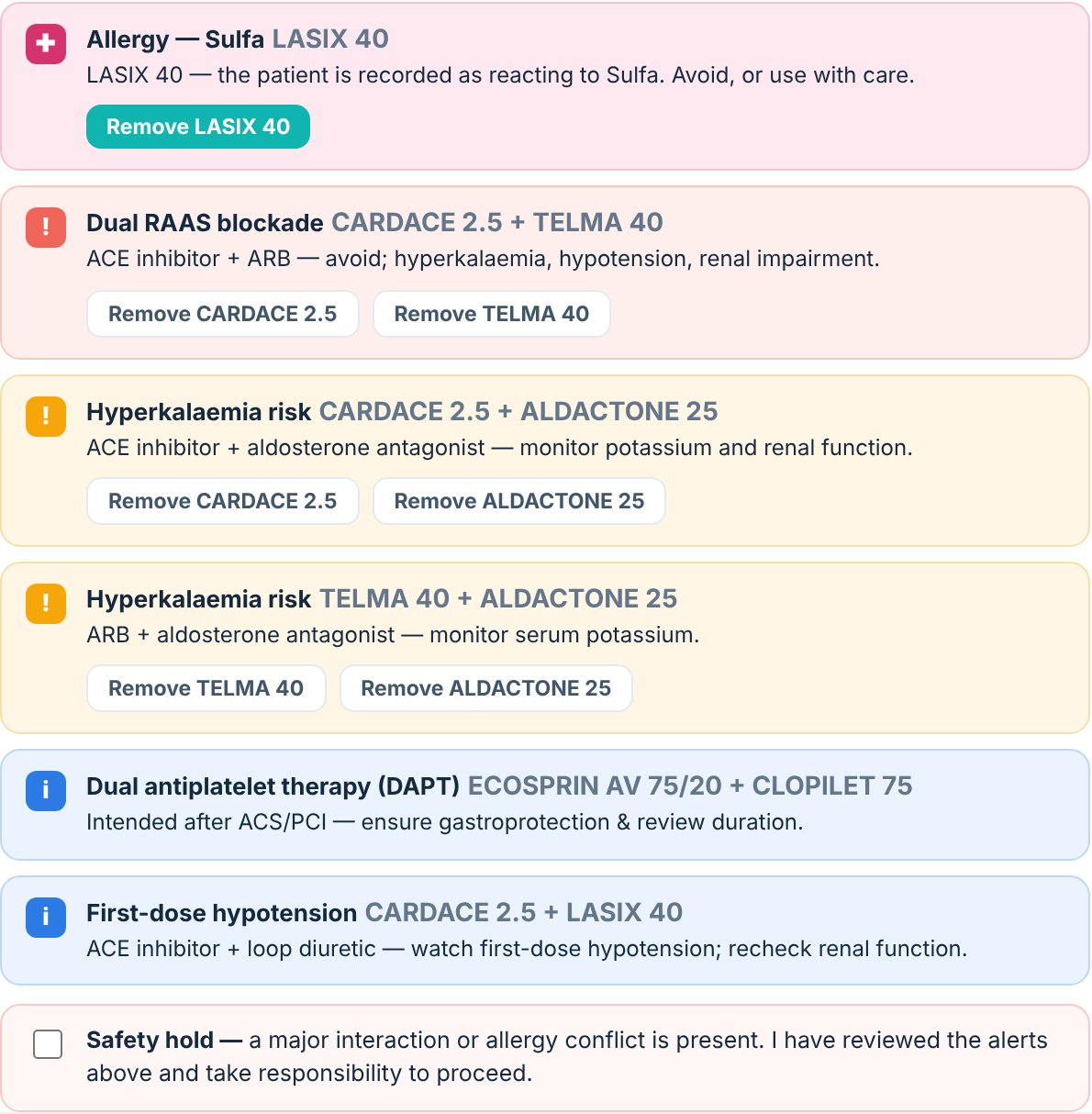
Twenty-nine drug pairs, seven duplicate-therapy classes, eleven allergy families and eighteen food-and-timing notes — the combinations a cardiac unit actually writes, not a licensed database bolted on. Clopidogrel with omeprazole does not just warn; it offers pantoprazole instead, in one tap. The same rules check the discharge prescription, because a discharge prescription and an OPD one are the same thing written on different days.
What it is not. It is a second pair of eyes, not a licence to stop using the first. The list is not exhaustive and does not pretend to be, and a brand the formulary has never heard of is checked against nothing — which the screen says, rather than passing silence off as safety.
The rest of it
Every screen below is the working software, photographed from the demonstration you can open — not a mock-up.
Everything else it does
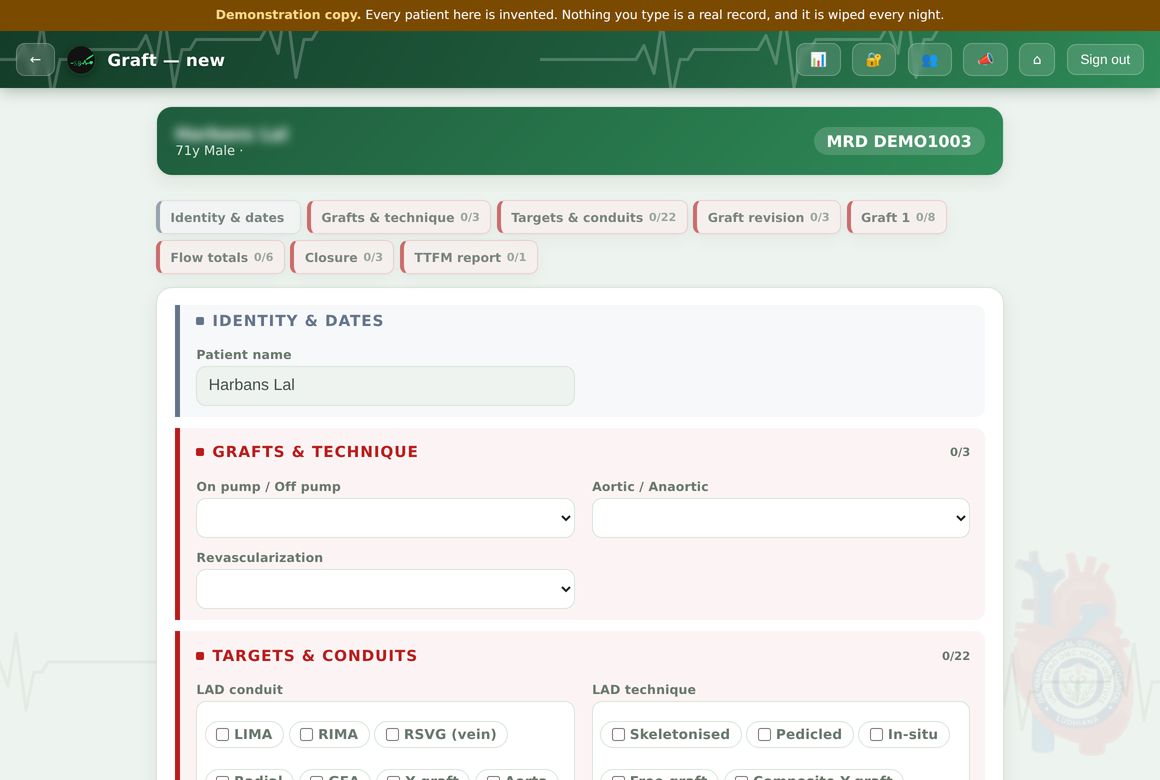
Fifteen linked forms, 944 boxes, one record per patient. Everything below is in the demonstration you can open — there is nothing on this list that is planned rather than working.
EuroSCORE II as the sheet is filled
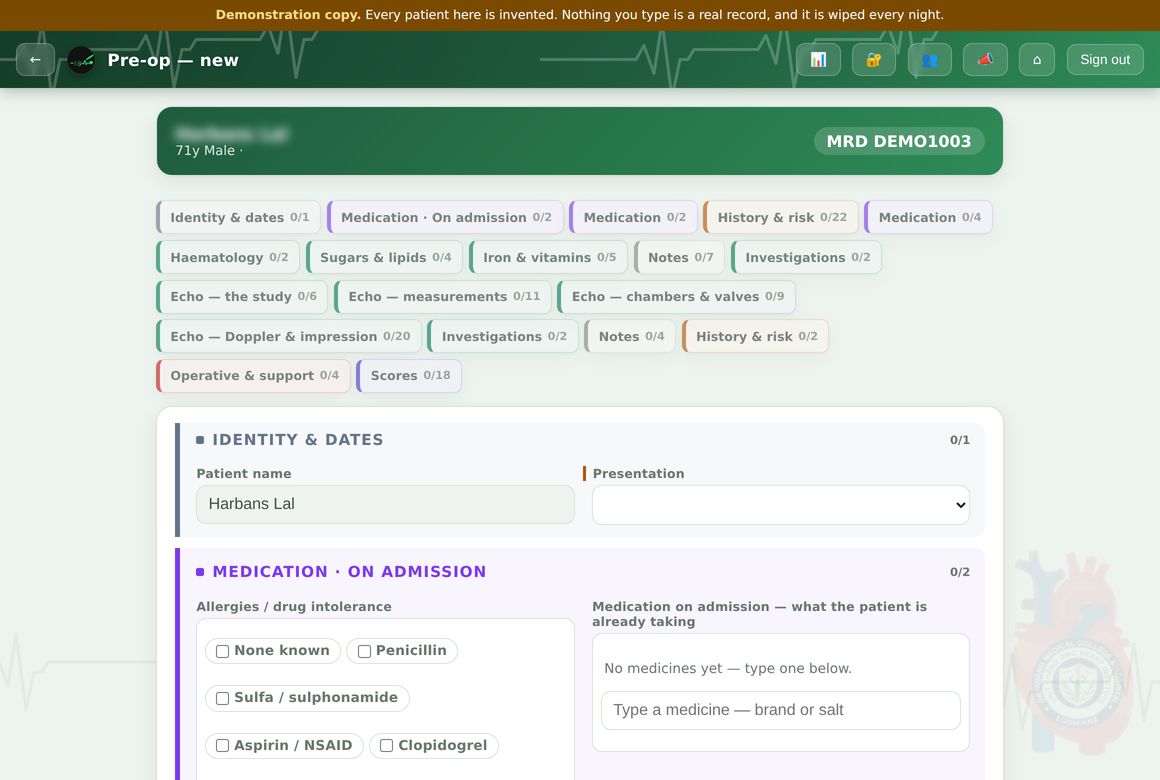
135 boxes on the pre-operative sheet, and the score recomputes as they are answered rather than at the end — so an implausible one is seen while the patient is still in front of you.
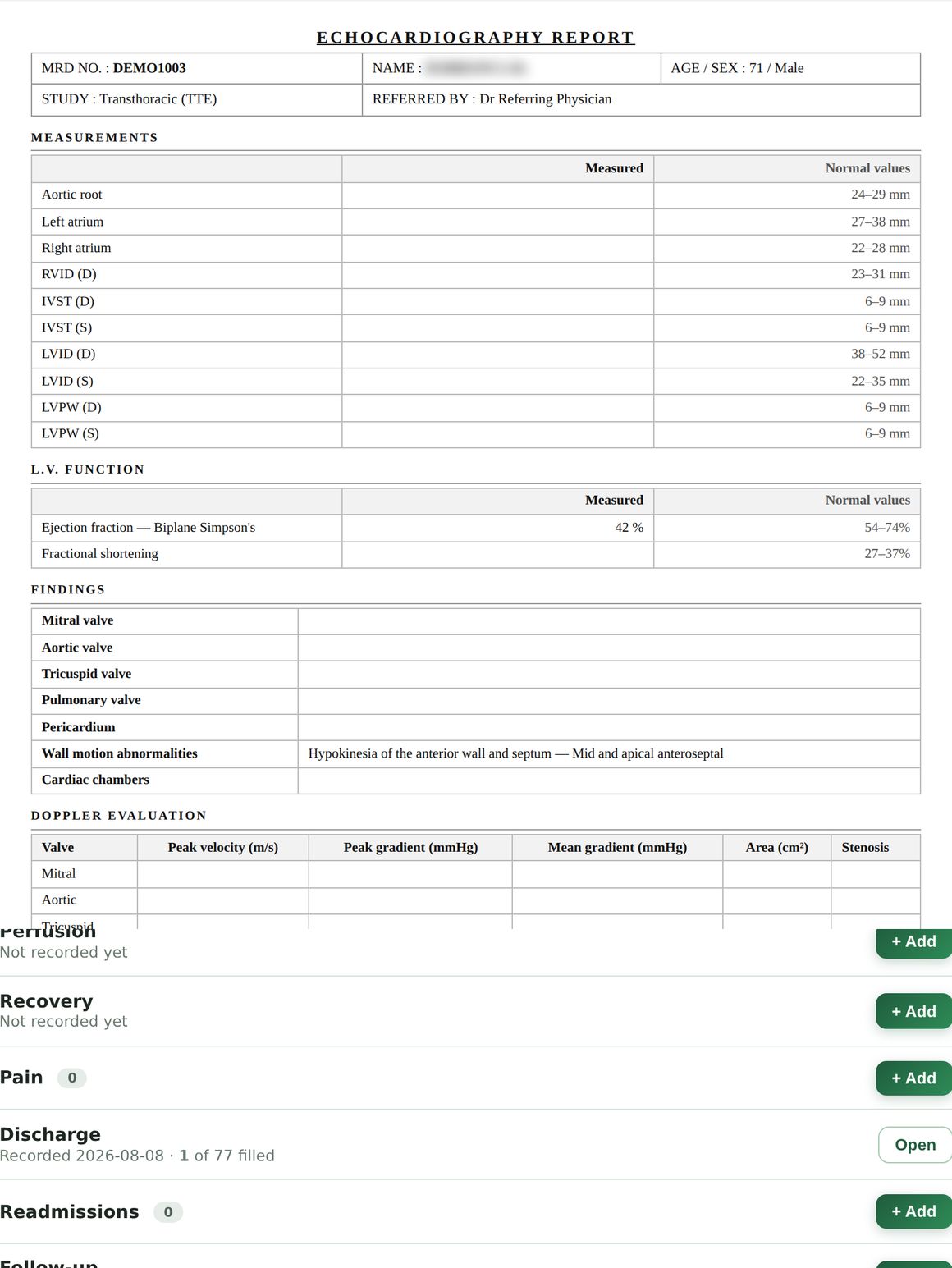
The study in full, and a report to print
Forty-seven echo boxes: chambers, valves, gradients, regional wall motion by segment. The printed report is the unit's own format, with the wall motion written out where it is present and said to be absent where it is not.
Twenty-five segments, weighted by dominance
Dominance is asked first because it decides which segments exist. Each lesion shows what the segment scored and what the characteristics added, separately, so a SYNTAX total can be read back to where it came from.
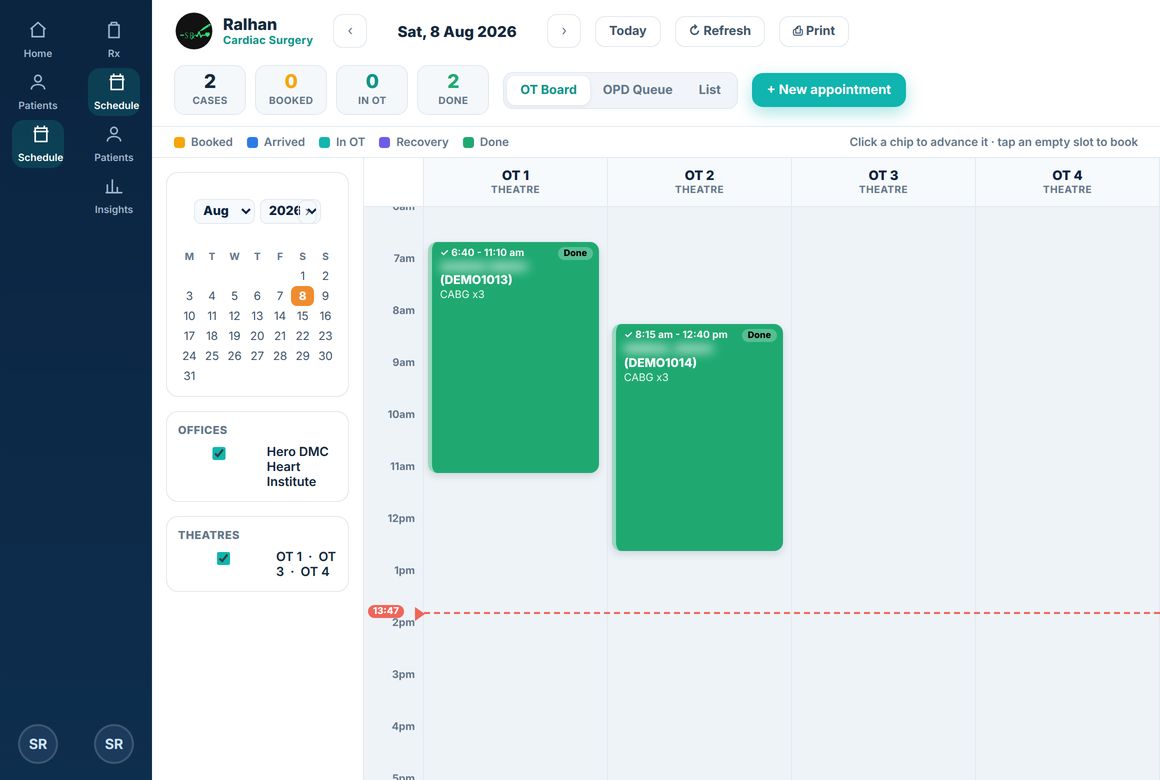
The day's list across four theatres
Times in and out, surgeon, anaesthetist, procedure; status advances on a tap. The operating list also sits on the front page, so the first screen of the morning is the one that matters.
Twelve graft blocks, folded to the ones you used
Conduit and target per graft. A three-graft case shows three blocks and one empty, not twelve — the rest are one tap away rather than nine screens of scrolling past nothing.
Inotropes at this unit's dilutions
Bypass and cross-clamp times, fluid balance, and infusions worked from the dilutions actually made up here — dopamine 200 mg, adrenaline 2 mg — rather than from a textbook's.
Summary, treatment chart and prescription, on letterhead
Printed on the hospital's own letterhead, with the treatment chart set the way the ward reads it. The discharge prescription is checked against the same interaction rules as the clinic's.
The review date becomes an appointment
Given at discharge, it appears in the OPD queue on the day. Tomorrow's list can be subscribed to in Google Calendar, so it arrives the night before without anybody sending it.
The next visit starts from the last one
Reopen a patient and the prescription comes back as it was written, with the diagnosis and the vitals — so a review is an edit rather than a re-typing.
They send their own reports in
A patient signs in on their phone and photographs a report done elsewhere. It arrives against their record, and the week's uploads are listed on the front page rather than waiting to be looked for.
Their own patients, and only those
A referring physician signs in and sees what happened to the patients they sent — which is the follow-up letter they usually have to ask for.
Requests come off the website into the registry
A request made on drralhan.com arrives on the front page with the slot it asked for, instead of in somebody's WhatsApp.
It knows which forms are late
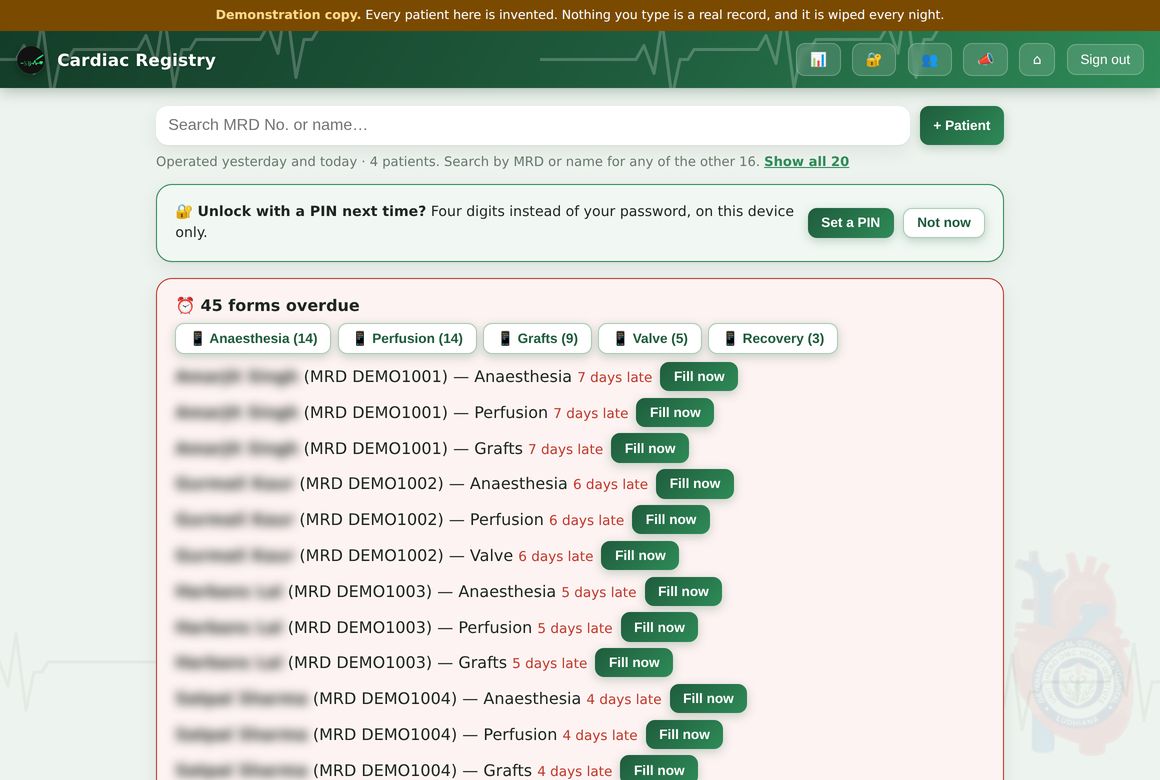
Overdue forms are listed by whose job they are, with a reminder that names every patient still outstanding for that area — so chasing is one tap, not a ward round of asking.
Permission by form, not by rank
A technician can be given the angiogram and lesion sheets and nothing else. Writing on the surgeon's letterhead is a separate permission from being an administrator, because they are separate things.
Every change, with who and when
An audit trail of what was altered, by whom, at what time — the thing a unit needs the day a number is questioned and nobody remembers.
A PIN on your own device
Four to six digits instead of a password, on a device you have already proved is yours, with obvious PINs refused. Any device can be revoked from the administrator's screen.
One Excel workbook, every table
A master sheet of one row per patient with the stage forms joined, and a sheet per table behind it. It is your data; taking it elsewhere should not need anybody's permission.
Backed up nightly, off the machine
Encrypted, to storage the server itself cannot reach into and delete, every night. A registry that exists in one place is a registry you have not really got.
Have a look round
A working copy, filled with twenty invented patients. Everything works — enter a lesion, print a prescription, advance a case through theatre.
Open the demonstration →Opens straight in — no sign-in to type.
If you would rather: demo.drralhan.com,
demo@drralhan.com · demo1234
Every patient here is invented, and their names are blurred in the pictures above. Invented or not, a name on a page that gets forwarded reads as a patient’s, and nobody seeing it second-hand can tell the difference — so it is not shown. Nothing in it comes from any real record — the names, ages, angiograms and prescriptions were written for it. It runs from its own database, separate from the clinical one, and everything typed into it is wiped each night. Do break it.